Coming soon · iPhone, iPad and Mac
Pro weather radar for storm chasers
Raw NEXRAD Level II from all 156 US radars: every product and tilt, dealiased velocity, NWS storm tracks with arrival times, and watches and warnings free. Pro adds dual-pol and the full archive.
Built for reading storms
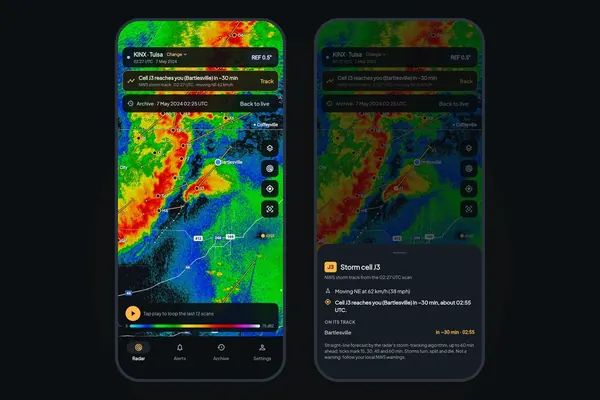
Storm tracks with arrival times
NWS storm tracks for every cell, and "reaches you in ~30 min" for your town. Free.
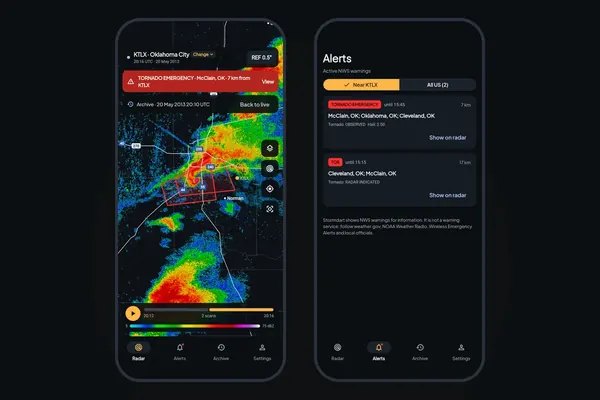
Watches and warnings, free
NWS warning polygons, watch counties and a banner for the nearest warning. Never behind the paywall.
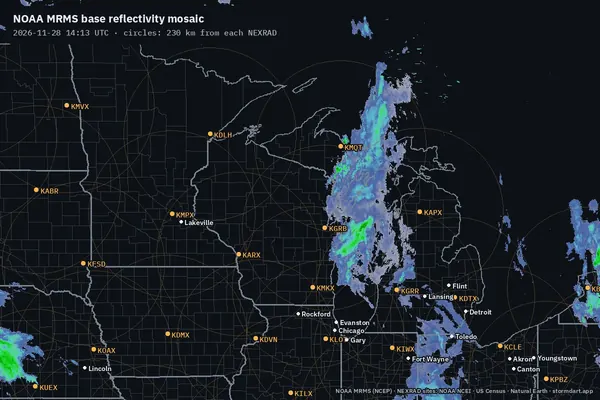
Nearby radars: the national mosaic around your radar
NOAA's MRMS mosaic around the radar you picked, so storms past its range still show.
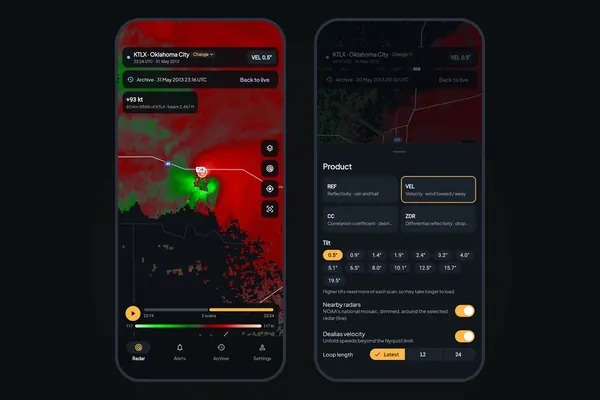
Dealiased velocity at every tilt
Velocities past the Nyquist limit unfolded automatically, so couplets read true. Free.
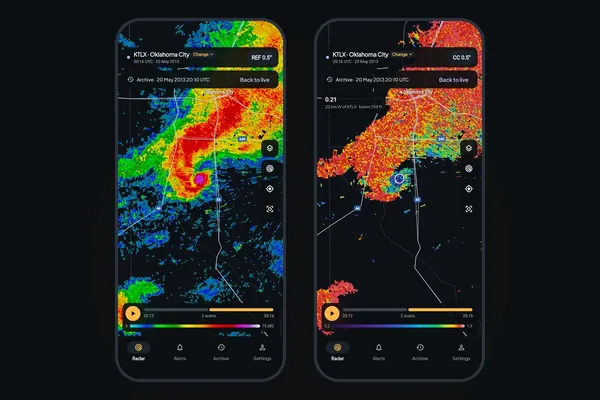
Dual-pol: correlation coefficient and ZDR
CC and ZDR at every tilt, for tornado debris signatures, hail and melting layers. Pro.
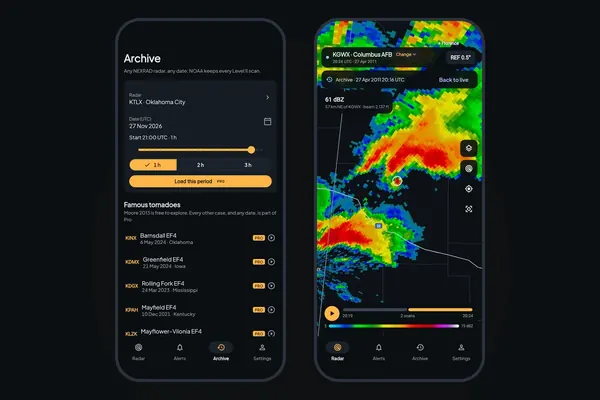
The radar archive and famous tornadoes
Any radar, any date since 2008, scan by scan, plus one-tap famous tornado cases.
Radar near you
Houston radar
Texas
KLOTChicago radar
Illinois
KINDIndianapolis radar
Indiana
KTBWTampa Bay radar
Florida
KFWSDallas–Fort Worth radar
Texas
KILNCincinnati radar
Ohio
KINXTulsa radar
Oklahoma
KOAXOmaha radar
Nebraska
KOHXNashville radar
Tennessee
KPBZPittsburgh radar
Pennsylvania
KCLECleveland radar
Ohio
KEAXKansas City radar
Missouri
Learn to read radar
How to Read Weather Radar Like a Storm Chaser
Reflectivity colors show how hard it is raining (dBZ), velocity shows wind toward (green) or away (red) from…
Radar Reflectivity and dBZ: What the Colors Mean
dBZ is a log scale of returned radar power: 20 dBZ is a trace of rain, 40 about 0.45 in/h, 50 about 1.9 in/h,…
Base vs Composite Reflectivity
Base reflectivity is the lowest 0.5° tilt. Composite shows the highest dBZ from every tilt. Composite finds…
Velocity Radar: How to Read Base Velocity
Base velocity shows wind along the radar beam: green toward the radar, red away, gray for zero. How to read…
Velocity Couplet: How to Spot Rotation on Radar
A velocity couplet is bright inbound beside bright outbound across the beam: rotation. How to measure Vrot,…
Storm-Relative Velocity (SRV) Explained
Storm-relative velocity removes the storm's own motion from base velocity so rotation stands out. When SRV…
Hook Echo: What It Means on Radar
A hook echo is a hook-shaped curl of reflectivity on the right-rear side of a supercell around its rotating…
Tornado Debris Signature (TDS) and the Debris Ball
A TDS is a spot of very low correlation coefficient (below about 0.85) right on a velocity couplet: debris…
Famous tornadoes on radar
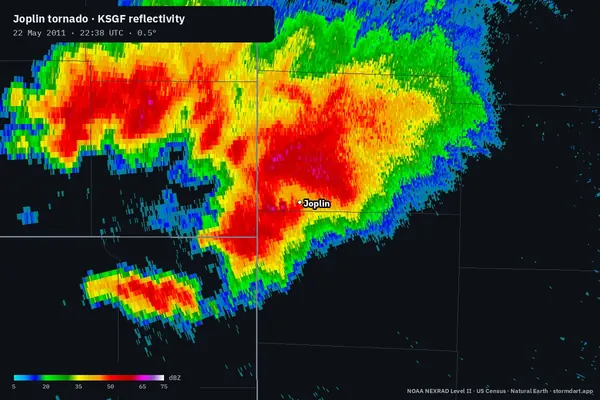
Joplin Tornado (2011) on Radar
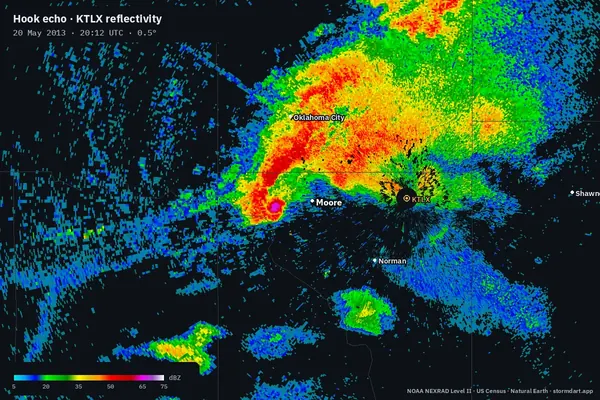
Moore Tornado (2013) on Radar
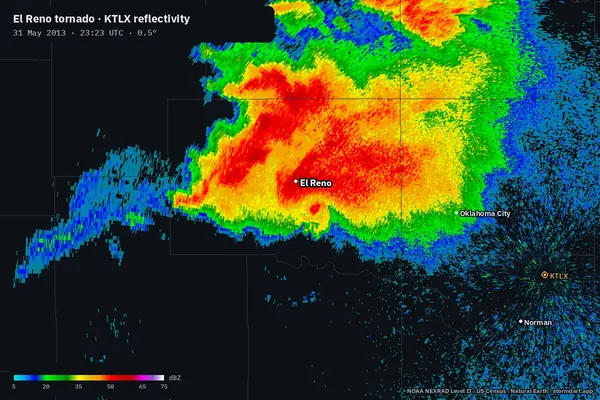
El Reno Tornado (2013) on Radar
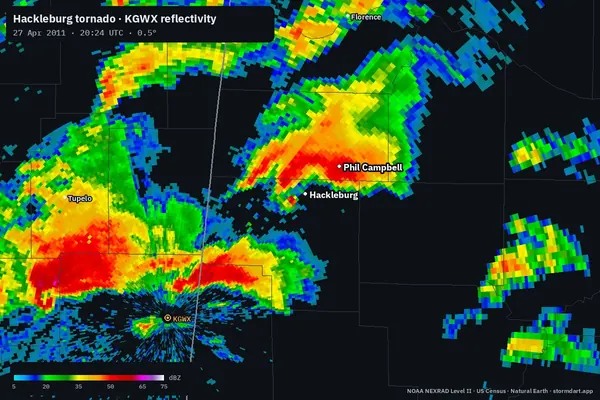
Hackleburg Tornado (2011) on Radar
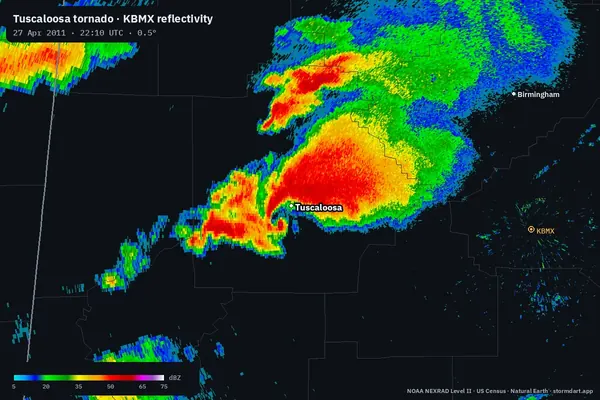
Tuscaloosa–Birmingham Tornado (2011) on Radar
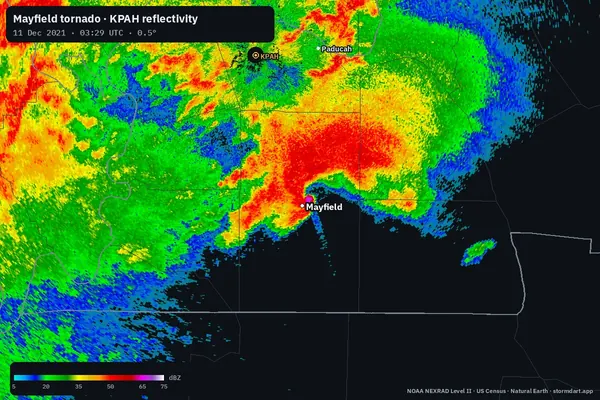
Mayfield Tornado (2021) on Radar
Questions
When is Stormdart coming out?
Stormdart for iPhone, iPad and Mac is finished and being prepared for App Review. Join the waitlist and we will email you once, on the day it is in the App Store.
What does it cost?
Stormdart is a free download, and the free radar stays free: live reflectivity and velocity at every tilt, NWS storm tracks, watches and warnings, nearby radars and 12-scan loops. Stormdart Pro adds dual-pol, the archive and 24-scan loops for $4.99 a month or $39.99 a year, with a 7-day free trial.
Will it work on Android?
Android is planned but not built yet. Choose Android on the waitlist form and we will email you when it is ready.
Where does the radar data come from?
From the National Weather Service's NEXRAD network, through NOAA's public Level II feed and archive. Stormdart decodes the raw data on your phone.
Is Stormdart a warning service?
No. Like every radar app it can be delayed or wrong. For warnings, follow the National Weather Service, NOAA Weather Radio and local officials.
Stormdart is not a warning service. For tornado and severe thunderstorm warnings, follow weather.gov, NOAA Weather Radio and local officials.