Learn
Free vs paid radar apps: what should be free
The radar data itself is free: NOAA publishes every NEXRAD scan, warning and mosaic for anyone to use. A good free radar app should give you live reflectivity and velocity, National Weather Service warnings and watches, and loops long enough to see storm motion. What is fair to pay for is analysis on top: dual-pol products, archives, longer loops, extra data such as lightning. Safety information should never be behind a paywall.
The data is free; the app is the product
All 156 US NEXRAD radars stream their Level II data to NOAA's public cloud feed, and NOAA keeps the whole archive there too. Warnings and watches come free from the NWS API, and the MRMS mosaic is public. The National Weather Service's own map at radar.weather.gov is free and has no ads. So when an app charges, you are paying for how it decodes, draws and explains the data, not for the data.
What a free radar app should include
| Feature | Why it belongs in free |
|---|---|
| Live radar with its scan time | The basic job; without the time you cannot tell a stale radar |
| NWS warnings and watches | Safety information; it is free from the NWS |
| Base velocity | The only way to see rotation and damaging winds on radar |
| A loop of the last half hour or more | You need motion to know what is coming (radar loops) |
| Your nearest radar, not only a smoothed national map | Hooks and couplets only show at full resolution |
Things that are reasonable to pay for: dual-pol products such as correlation coefficient, the archive, long loops, lightning, multi-pane layouts and syncing across devices.
How radar apps split free and paid today
From the App Store listings we read on 27–28 November 2026 (prices and tiers change; check before you buy):
| App | Up front | Subscription |
|---|---|---|
| RadarScope | $9.99 | Pro Tier 1 $9.99 a year; Pro Tier 2 $14.99 a month or $99.99 a year (archives, MRMS, more) |
| Stormdart | Free | Pro $4.99 a month or $39.99 a year, 7-day free trial |
| NWS radar.weather.gov | Free | None |
Details of each are on our RadarScope comparison, RadarOmega comparison and best radar apps pages.
Stormdart's split
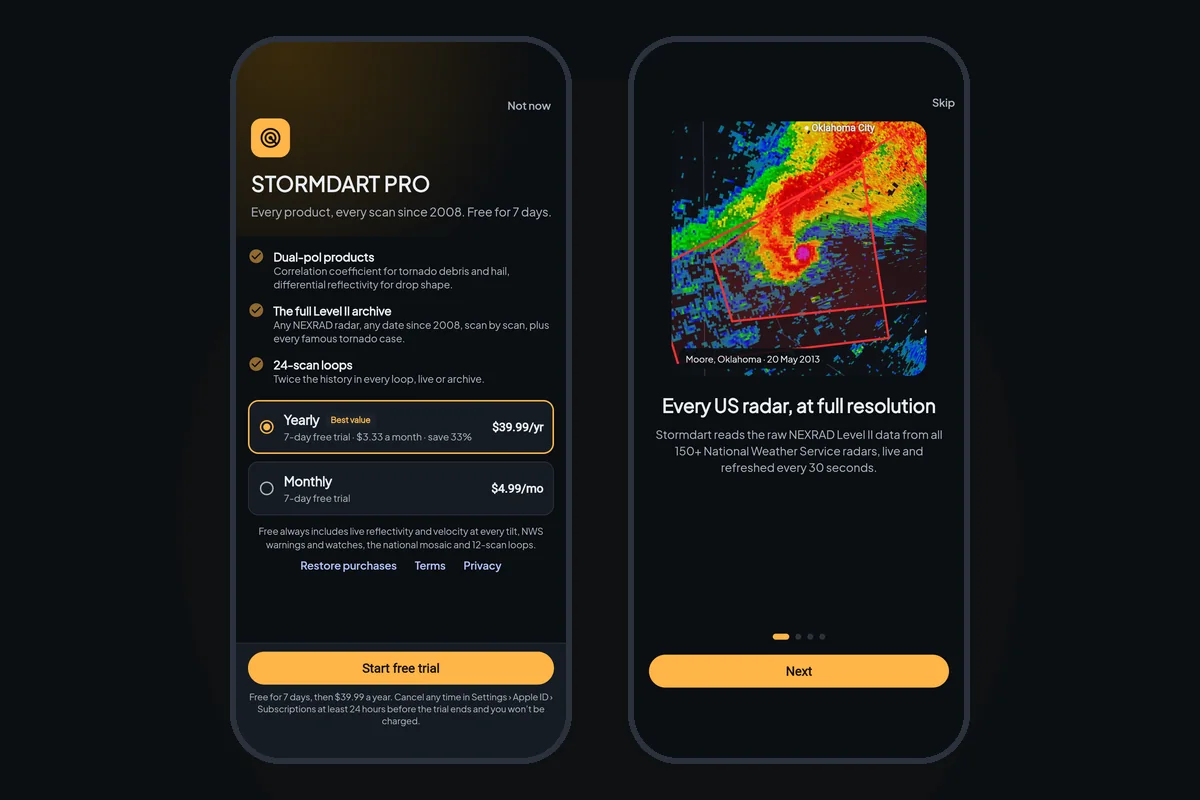
Our own app, so judge accordingly. Free: live reflectivity and velocity from every radar at every tilt (dealiased), the tap readout, NWS storm tracks with arrival times, watches and warnings, nearby radars, the radar outage alert, the widget, 12-scan loops and the Moore 2013 case. Pro adds CC and ZDR, the archive for any radar and date with every famous case, and 24-scan loops. No ads, no account. The Pro screen above is the real one; its fine print says free always includes live reflectivity and velocity at every tilt, NWS warnings and watches, the national mosaic and 12-scan loops.
How to test a radar app in five minutes
- Open it on your nearest radar and compare the scan time with the clock.
- Find velocity, and check whether you can step up through the tilts.
- Look for watches and warnings on the map, and tap one: does it show the NWS text and tags?
- Play a loop: how many frames, and how far back?
- Check what happens when a radar is down: does the app say so?
Then read the subscription screen before the trial ends: what is in free, what is in paid, and how to cancel. If you are new to radar, start with how to read weather radar so you know what you are paying for.
Free radar for storm chasers and spotters
If you chase or spot, the free tier matters more than for most people, because you need it in the field on a phone with a weak signal. Look for velocity at more than the lowest tilt (rotation is often clearer a tilt or two up), a tap readout that gives distance and beam height, and a way to switch quickly to the next radar when you drive out of range. Paid extras such as dual-pol are genuinely useful for confirming a debris signature or finding hail, but they do not replace good basic velocity. And whichever app you use, storm chasing safety and SKYWARN spotter training come first.
Watch out for
- Ads over the map, which can cover the storm you are watching.
- Forecast-model "future radar" presented like radar. It is a model guess, not an observation.
- No timestamp on the image.
- Warnings in a paid tier. Free NWS alerts and Wireless Emergency Alerts should be on whatever app you use.
Questions
What is the best free weather radar app?
One that gives you your nearest radar live, with velocity, warnings and the scan time, without ads over the map. The free NWS site radar.weather.gov covers the basics; Stormdart's free version adds velocity at every tilt, storm tracks and warnings.
Is RadarScope free?
No. RadarScope costs $9.99 up front on the US App Store, with optional Pro subscriptions, as listed on 27 November 2026.
Why do some radar apps charge if NOAA data is free?
Decoding raw radar data, drawing it fast, keeping servers and building features costs money; the data itself is free to everyone.
Sources
- NEXRAD on AWS (Registry of Open Data on AWS) (registry.opendata.aws)
- National Weather Service radar (radar.weather.gov)
- RadarScope on the App Store (apps.apple.com)
- API Web Service (National Weather Service) (www.weather.gov)
Keep reading
The best weather radar apps for storm chasers in 2026
Which weather radar app to use for storm chasing in 2026: what RadarScope, RadarOmega and the free NWS radar offer, and…
CompareStormdart vs RadarScope
RadarScope's price, Pro tiers and features as listed on the App Store today, next to what Stormdart has built and what…
Feature · freeWatches and warnings, free
Stormdart draws NWS tornado and severe thunderstorm warnings and SPC watch counties over live radar, with a banner for…
LearnHow to Read Weather Radar Like a Storm Chaser
Reflectivity colors show how hard it is raining (dBZ), velocity shows wind toward (green) or away (red) from the radar,…
LearnHow to add a radar widget to your iPhone and CarPlay
Add a weather radar widget to your iPhone Home Screen or Lock Screen in a few taps, what a good radar widget shows, and…
FeaturesA radar app built for storm chasers
Everything Stormdart does, with real screenshots: Level II from 156 radars, dealiased velocity, storm tracks, free…