Feature · Pro
Dual-pol: correlation coefficient and ZDR
Every NEXRAD radar is dual-polarized. Stormdart Pro shows correlation coefficient (CC) and differential reflectivity (ZDR) at every tilt, masked where reflectivity is too weak to mean anything. CC is how meteorologists confirm a tornado debris signature: a small spot of low CC inside a hook and a velocity couplet.
A debris signature in the app
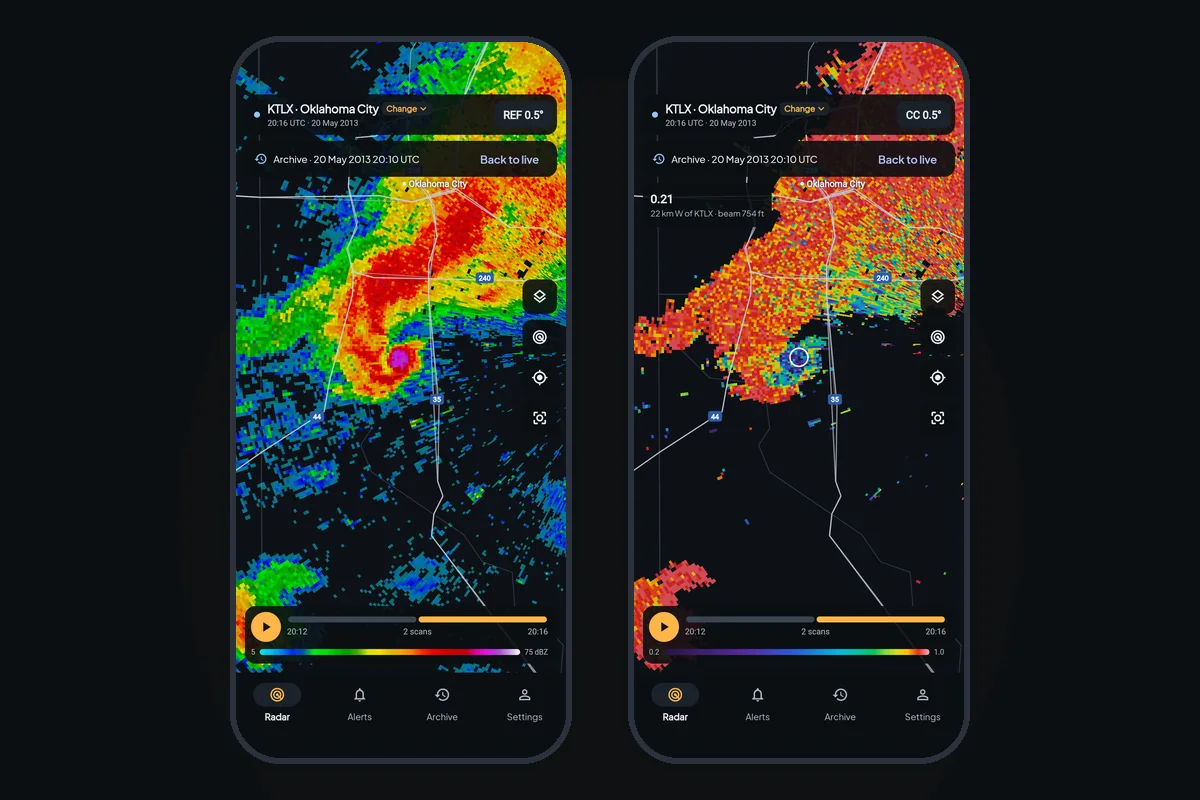
Both screens show KTLX at 20:16 UTC on 20 May 2013, as the Moore tornado crossed the city. On the left, reflectivity: the hook with a rounded high-reflectivity knot at its end. On the right, correlation coefficient at the same spot: a blue patch inside red rain, and a tap there reads CC 0.21, 22 km west of the radar with the beam only 754 ft up. Rain gives CC near 1; values that low mean the radar is hitting a jumble of shapes, which in a hook with a couplet means lofted debris.
What dual-pol is good for
| Product | What it shows | Use it for |
|---|---|---|
| CC (correlation coefficient) | How alike the targets in a gate are | Debris signatures, the melting layer, non-weather echoes |
| ZDR (differential reflectivity) | Whether targets are wider than tall | Big raindrops vs hail, ZDR columns in updrafts |
Our guides to correlation coefficient and dual-pol radar go deeper, with more real scans.
Free and Pro
Dual-pol is part of Stormdart Pro ($4.99 a month or $39.99 a year, with a 7-day free trial). A debris signature confirms a tornado that the National Weather Service will already be warning on; the warnings themselves are free in Stormdart. See free vs Pro.
Stormdart is being prepared for App Review and is not in the App Store yet. Join the waitlist for one email on the day it is.
Questions
Is CC a tornado detector?
No. Low CC also comes from hail, the melting layer, birds and insects, and ground clutter. It points to debris only together with a hook, a strong couplet and reflectivity in the right place.
Which radars have dual-pol?
All of them: the NEXRAD network was upgraded to dual polarization in the early 2010s, so every radar on this site has CC and ZDR in Stormdart. For archive storms, dual-pol exists only after each radar was upgraded.
Sources
- RAC Base and Derived Products: dual-pol lessons (NWS Warning Decision Training Division) (training.weather.gov)
- Next Generation Weather Radar (NEXRAD) (NOAA NCEI) (www.ncei.noaa.gov)
Keep reading
Tornado Debris Signature (TDS) and the Debris Ball
A TDS is a spot of very low correlation coefficient (below about 0.85) right on a velocity couplet: debris lofted by a…
LearnCorrelation Coefficient (CC) on Radar
CC shows how alike the targets in a radar beam are: above 0.97 is rain or snow, 0.80 to 0.97 mixed or hail, below 0.8…
LearnDual-Pol Radar: ZDR, CC and KDP Explained
Dual-pol radar uses horizontal and vertical pulses to measure target shape (ZDR), uniformity (CC) and liquid water…
Tornado caseMoore Tornado (2013) on Radar
The 20 May 2013 Newcastle–Moore EF5 killed 24 people. KTLX, 18 km away, showed a hook, tight couplet and debris…
Feature · ProThe radar archive and famous tornadoes
Open any NEXRAD radar on any date since 2008 from NOAA's Level II archive, scan by scan, plus one-tap famous tornado…