Learn
Tornado Season: When and Where Tornadoes Happen
In the United States, tornado season peaks from April through June, and May is the busiest month: in the Storm Prediction Center's records for 1995 to 2024, May averaged about 282 tornadoes, 22% of the year, and April to June together made up 53%. The peak moves north as the year goes on: the Gulf Coast sees its peak earlier in spring, the southern Plains in May into early June, and the northern Plains and upper Midwest in June or July. Tornadoes happen in every month, and parts of the Southeast have a second, smaller season in late fall.
Tornadoes by month
We averaged every tornado in SPC's official U.S. database for the 30 years 1995 to 2024, about 1,263 a year. We start in 1995 because, as SPC notes, tornado reports rose around the installation of the NEXRAD radar network in the mid-1990s, mostly weak ones that used to go unreported.
| Month | Average tornadoes | Share of the year |
|---|---|---|
| January | 45 | 3.6% |
| February | 38 | 3.0% |
| March | 91 | 7.2% |
| April | 192 | 15.2% |
| May | 282 | 22.3% |
| June | 196 | 15.5% |
| July | 114 | 9.0% |
| August | 83 | 6.6% |
| September | 64 | 5.1% |
| October | 63 | 5.0% |
| November | 52 | 4.1% |
| December | 43 | 3.4% |
Even the quietest months average around 40 tornadoes. SPC notes that the average date of the year's first U.S. tornado was 11 January over 1950 to 2011, and that how active late winter is says nothing about the spring that follows.
Tornado season by state: the peak moves north
NOAA describes a general northward shift in tornado season from late winter through mid-summer, because spring arrives later the farther north you go. Our state numbers from the same SPC data (a tornado crossing a state line counts in each state) show it clearly:
| State | Tornadoes per year | Busiest month (share) | Next busiest |
|---|---|---|---|
| Mississippi | 59 | April (25%) | March (13%), December (12%) |
| Alabama | 59 | April (25%) | March (15%), November (11%) |
| Louisiana | 46 | April (21%) | May (12%) |
| Texas | 133 | May (30%) | April (19%) |
| Oklahoma | 70 | May (48%) | April (21%) |
| Kansas | 82 | May (44%) | June (18%) |
| Iowa | 56 | May (25%) | June (22%) |
| Illinois | 63 | May (25%) | April (19%) |
| Colorado | 45 | June (32%) | May (26%) |
| Minnesota | 45 | June (29%) | July (25%) |
| North Dakota | 29 | June (40%) | July (32%) |
| Florida | 58 | September (13%) | June (12%) |
Oklahoma is the most concentrated: almost half its tornadoes come in May. North Dakota's season is June and July. Florida is the odd one out, with tornadoes spread across the year and no strong spring peak.
The fall season in the Southeast
In the Deep South the calendar has two humps. In Alabama, November is the third-busiest month, and in Mississippi December is. The NWS office in Huntsville, Alabama shows the same thing in its own records: a second-season spike in October and November, with events such as the 15 November 1989 tornado and the 2002 Veterans Day weekend outbreak. NOAA's VORTEX-USA research adds why these are dangerous: Southeast tornadoes more often come at night and in fast-moving storms, with poorer visibility.
Time of day
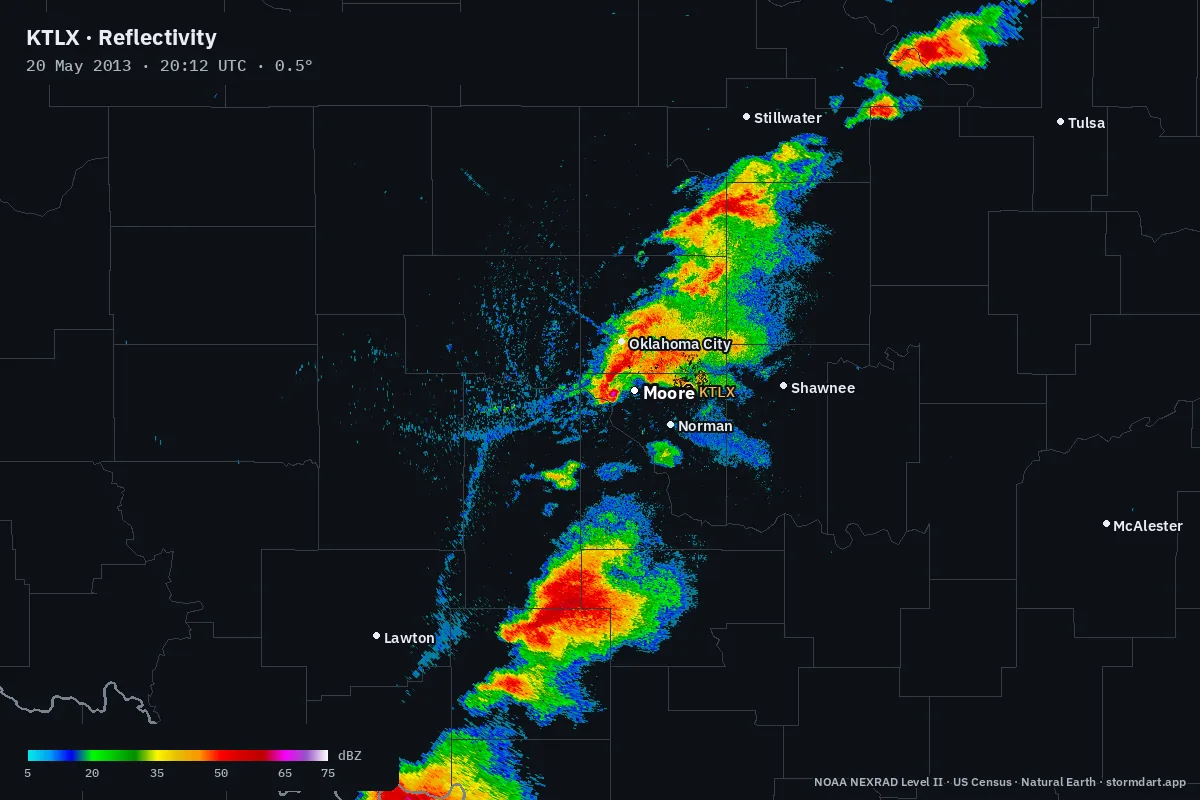
The Moore tornado struck in peak season, 20 May, though a little earlier in the day than most: this KTLX scan at 20:12 UTC (3:12 pm CDT, 2:12 pm CST) shows the supercell's hook over Moore, part of a line of storms running from north of Stillwater to past Lawton. NSSL says most tornadoes occur between 4 and 9 pm. SPC records times in Central Standard Time; in our 1995 to 2024 count, 48% of tornadoes started between 4:00 and 8:59 pm CST, and 21% between 8 pm and 6 am CST, in the dark for much of the year. Night tornadoes are the ones people are least able to see, so a way to be woken by a warning matters.
What the season means for you
- Get ready before your local peak, not in it: check your shelter, your NOAA Weather Radio and phone alerts in late winter in the South and in spring farther north.
- Don't relax in winter if you live in the Southeast. Tornadoes in November through February are less frequent but very real there.
- Watch the outlooks. In season, the SPC convective outlook tells you days ahead when your area has a severe risk.
- Know the alerts. A tornado warning means shelter now, in any month.
For storm chasers, May and early June on the southern and central Plains remain the classic season (see storm chasing and Tornado Alley).
Questions
When is peak tornado season?
Nationally, April through June, with May the busiest month: about 22% of all U.S. tornadoes in SPC records for 1995 to 2024. The local peak is earlier in the South and later in the North.
What month has the most tornadoes?
May, with about 282 tornadoes on average in 1995 to 2024. June and April follow with about 196 and 192.
When is tornado season in Oklahoma and Texas?
Mainly May into early June. In 1995 to 2024, May alone brought 48% of Oklahoma's tornadoes and 30% of Texas's, with April second in both states.
Is there a fall tornado season?
Yes, in parts of the Southeast. Alabama and Mississippi records show a secondary peak in November and December, and NWS Huntsville highlights a fall spike in October and November.
Sources
- Severe Weather 101: Tornado Basics (NOAA National Severe Storms Laboratory) (www.nssl.noaa.gov)
- The Online Tornado FAQ (NOAA Storm Prediction Center) (www.spc.noaa.gov)
- Storm Prediction Center Maps, Graphics, and Data Page (www.spc.noaa.gov)
- Tennessee Valley Fall Tornado Climatology (NWS Huntsville) (www.weather.gov)
Keep reading
Tornado Alley: Where It Is and How It Is Shifting
Tornado Alley is a nickname, not an official zone, for the central U.S. Which states get the most tornadoes, and what…
LearnSPC Convective Outlooks: Risk Levels Explained
SPC outlooks rate severe storm risk 1 to 5: Marginal, Slight, Enhanced, Moderate, High. What each level means, how…
LearnTornado Watch vs Warning: What's the Difference?
A tornado watch means tornadoes are possible in a large area: get ready. A tornado warning means one is happening or…
LearnStorm Chasing: A Beginner's Guide
An honest beginner's guide to storm chasing: the real dangers, spotter training first, never core-punching, which gear…
Tornado caseMoore Tornado (2013) on Radar
The 20 May 2013 Newcastle–Moore EF5 killed 24 people. KTLX, 18 km away, showed a hook, tight couplet and debris…